
Published on staffbridge.co · Logistics · Case Study
Most U.S. logistics companies pay their brokers without thinking too hard about what that actually costs them. It's just part of how freight works.
Until you sit down and do the math.
Ten percent on every load. Minimum $100 per move, no matter the lane. And if you're running consistent freight through three or four brokers at the same time (which most companies do) you're not just paying broker margins. You're bidding against yourself every single day.
That's what was happening to a U.S. based final mile delivery company before they started working with StaffBridge. And it's what stopped happening when they did.
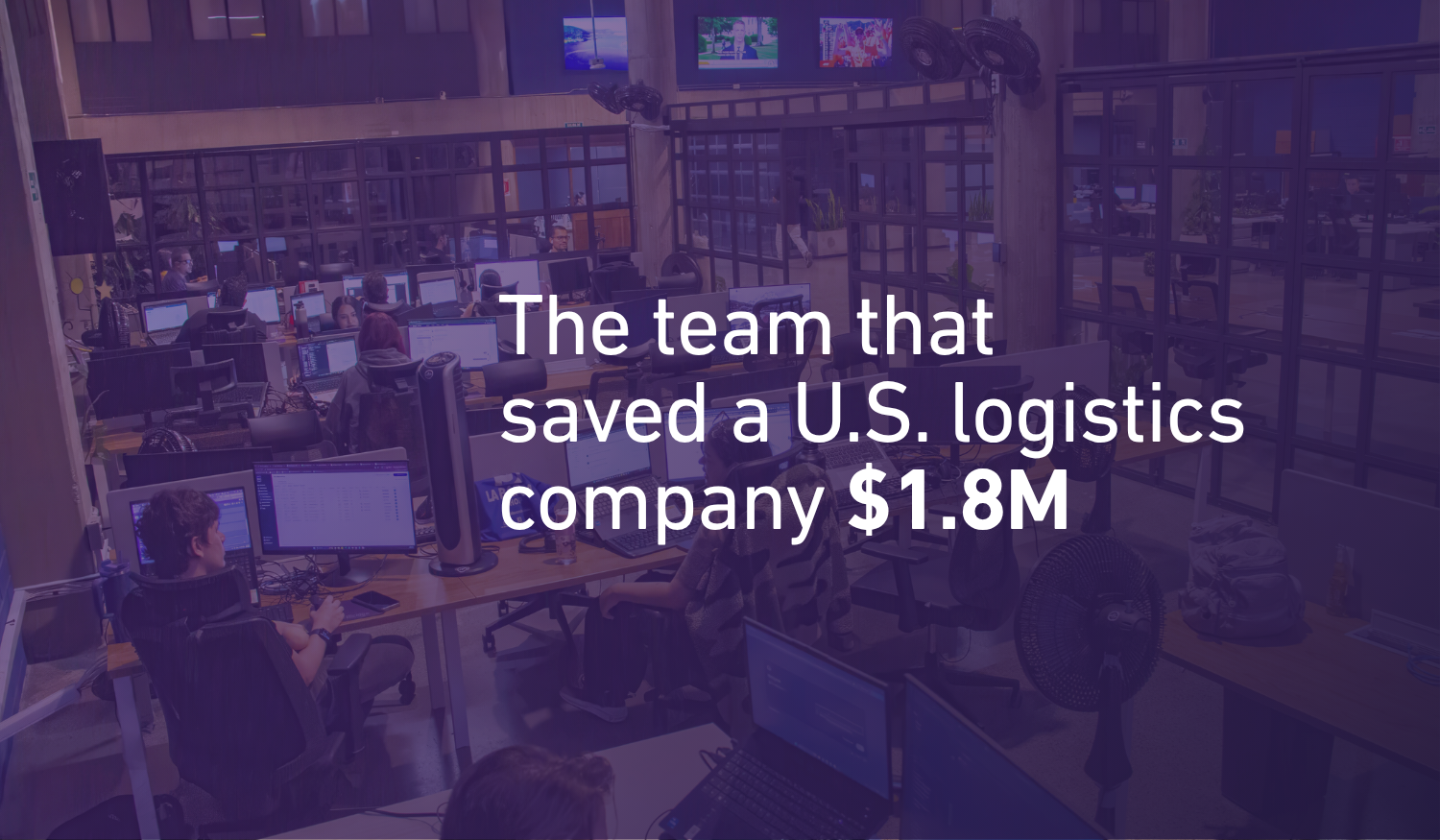
In their first year working with a dedicated nearshore operations team in Medellín, Colombia, they saved $1.8 million. Their on-time delivery rate reached 98%. Their internal logistics coordination team, burned out and ready to quit, was replaced entirely. And the two original hires from that Medellín team are still in their seats, seven years later.
This is how it happened.
The problem most freight companies don't see
The company had something most freight operators would envy: consistent, predictable lanes. The same freight, the same routes, week after week. Volume was growing. The business was working.
But their freight was being handled by multiple brokers simultaneously. Each broker took the same load to market independently. Each one talked to the same carriers. And each one was bidding against the others, inflating what the carriers were willing to charge, every single time.
It's a structural problem that's almost invisible when you're inside it. The volume looks like one thing. The market sees something else entirely. And the company had no data to prove the difference because their internal team was too overwhelmed to keep analytical records.
Dave Sherman, StaffBridge's founder, was actually one of those brokers. He was handling about 10% of their freight volume and making $30,000 a month in broker fees off a single account. He knew the lanes. He knew the carriers. And he knew exactly how much the company was overpaying.
I shouldn't be telling you this because it's going to cut me out of a job, but I could build you a team here that does exactly what I'm doing, exactly what TQL is doing, exactly what your Coyote rep is doing. Bring you directly to the truck. There's going to be significant savings.
— Dave Sherman, Founder & CEO, StaffBridge
The proposal: eliminate the broker layer entirely

The pitch was simple. Instead of a broker relationship, StaffBridge would build a small, fully employed operations team in Medellín, Colombia. That team would own the carrier relationships directly, consolidate the freight volume, and run the lanes without a middleman.
The client would stay in full control of their operation. StaffBridge would handle the back-end: employment contracts, payroll, benefits, office space, and compliance. The Medellín team would work U.S. hours, use the client's systems, and manage their freight as if they were an in-house department.
It took two rounds of proposals and several months of back-and-forth before the client said yes. Their internal team was at breaking point by the time the engagement started, and when StaffBridge came in, they handed over everything at once instead of lane by lane.
The first months were brutal. The team was running fifty loads a day with a skeleton crew, working until 1 or 2am, covering for a client team that had already mentally checked out.
One of the original Medellín hires (call him John) was the lead on the account. He had been with Dave since before StaffBridge existed, showed up every day unpaid for months, and knew the client's lanes better than anyone. The night his wife went into labor, he was in the office. Dave called him, ready to hand the account back. John refused. He left, came back, and they delivered.
Seven years later, John runs that team. His wife still brings it up.
The results: $1.8M in year one
By eliminating broker margins and consolidating freight volume under direct carrier contracts, the company saved $1.8 million in their first twelve months. That's not a projection or a model, it's what happened when you take 10% broker fees off fifty consistent lanes and stop letting multiple brokers bid the same load against each other.
On-time delivery performance reached 98%. For a final mile company, that number carries specific weight: a single late line haul means two thousand individual downstream delivery failures for their end customers. They hadn't measured OTD before Staffbridge because they didn't have the bandwidth to track it.
Within three months, the client's internal logistics team had been replaced entirely by the Medellín team. The handover was faster than planned because their internal team was already done.
The two original hires are still in their seats. The client is still a Staffbridge client.
I don't really get value out of an individual until about month six, when they start really catching into the Gulf Stream. Our goal is to have the same individuals in those seats from day one to year six.
— Dave Sherman, Founder & CEO, StaffBridge
What this means for U.S. logistics companies
This wasn't a cost-cutting exercise. The client wasn't in financial trouble. They were growing, and the broker model was the hidden cost of that growth.
The StaffBridge model works because it eliminates the structural friction of the broker relationship without replacing it with the structural friction of offshore coordination. The team is in Medellín, same time zone as U.S. East Coast, real office, fully employed with benefits. They're not contractors. They're not a platform. They're professionals with a career in a company that invests in them.
That's why the retention numbers look the way they do. And retention is the actual product. A nearshore team that turns over every six months costs more than the broker you replaced.
The broker who was calling Dave every week, desperate to get back on the account? He was making $65,000 a month in fees from a single client relationship. Of course he was desperate. The company finally understood what they had been paying for.
If your logistics operation is running consistent lanes through broker relationships, we can show you exactly what that's costing you.